







Hydro-chemo-mechanical couplings within mucoid tissues (such as hyaline cartilage , bladder, stomach tissues…) are essential to bond micro- and macro-scale and explain interactions in between cell behavior and effective tissue response (Baldit, 2013; Uzuner et al., 2020; Ortun-Terrazas et al., 2021; Galbusera et al., 2011). In fact, mastering such couplings is a key element to understand biological tissues’ complex synergy and propose predictive tools on their bioactivity wherein local poro or hydro mechanical and chemical states play a major role (Lacroix et Prendergast, 2002, Lacroix et al., 2019). Ever since, once applied to biological tissues, biomechanical modelings fail to explain the inter-location and inter- donor variability even though tissue compositions are similar (Baldit, 2018). Biological tissues are complex materials due to their multi-physics but also bioactivities related to a memory through growth and remodeling (Fung, 1993; Latorre et al., 2018). Large experimental data collections are consequently required to be able to set a sound numerical model with optimized parameters generating predictive simulations to improve mucoid tissue’s behavior insights and extend it to clinical applications (Chetoui et al., 2022; Ortun-Terrazas et al., 2021; Galbusera et al., 2011; Wilson et al., 2005).
Therefore, HyCareMat’s main objective is to build a crosstalk between experiments, numerical simulations and modeling (multiscale behavior laws) to investigate and predict hydro-chemo-mechanical couplings in soft biological tissues, with a focus on mucoid matrices. As a first step, it requires a well known tunable biological material model to feed inverse method procedure and validate virtues of the ensued predictive tools. With respect to recent work of the HyCareMat consortium (Baldit et al., 2022; Dubus et al., 2022; Scomazzon et al., 2021; Scomazzon et al., 2024), WJ appears to be a suitable and tunable material exhibiting hydro-chemo-mechanical interactions. Ensuring the umbilical cord flexibility, the major role of the WJ is the resistance to torsional and compressive stresses imposed upon the umbilical vessels during fetal development (Bacsich et Riddell, 1945). Besides its protective role, the WJ is a rich reservoir of growth factors and contains significant amounts of collagen, hyaluronic acid and glycosaminoglycans (GAGs). This composition lends credence to its use as a graft for difficult-to-heal wounds (Scomazzon et al., 2021; Scomazzon et al., 2024; Beiki et al.,2017). Representing a valuable opportunity for the development of biological scaffolds, as they can be easily achieved both from a technical and an ethical point of view, WJ was extensively investigated by biologists (Dubus et al., 2022; Scomazzon et al., 2021; Scomazzon et al., 2024; Beiki et al.,2017) but poorly by biomechanicists (Baldit et al., 2022; Pennati, 2001; Gervaso et al., 2014). As a second objective, the WJ derivative materials will be deeply investigated to master their hydro-chemo-mechanical behavior and produce predictive numerical tools. Finally, switching from the passive biomechanical characterizations of the two previous objectives, the third objective focuses on the impact of bioactivity on the hydro-chemo-mechanical behavior of this promising material by monitoring host’s response and tissue integration. Therefore, a murine animal model will be set to collect in vivo data on implanted WJ structures. This ultimate step will validate our tools to select the best WJ-derived material for medical applications based on biomechanical characteristics, pushing towards human applications.
The main hypothesis consists to consider couplings between solid and fluid phases, as well as the chemical components of both, more precisely GAGs combined to collagen and electrically charged physiological fluid ions. The fluid structure interaction will be modeled as a homogenized continuous medium within the framework of poromechanics (Chetoui et al., 2022; Uzuner et al., 2020; Ortun-Terrazas et al., 2021; Galbusera et al., 2011; Derrouiche et al., 2019; Mow et al., 1980; Lanir, 1987) while the chemo-mechanical coupling will be generated by chemical potential balance through osmosis (Chetoui et al., 2022; Ortun-Terrazas et al., 2021; Galbusera et al., 2011; Wilson et al., 2005). Based on preliminary results, it is considered that tuning crosslinks (Scomazzon et al., 2024; Adamiak et Sionkowska, 2020) and GAGs content (Scomazzon et al., 2021; Legouffe et al., 2022; Davidenko et al., 2015), on geometrically controlled structures, is sufficient to modulate interaction phenomena (i.e. discriminating hydro-mechanical from chemo-mechanical couplings). Finally, combining multimodal imaging techniques while performing hydro-chemo-mechanical loads and monitoring animal’s response to material integration is expected to provide enough data in order to build predictive tools.
Consortium
Ce projet a un budget actuel de 563k€+58k€ (de la Région Grand Est) et implique quatre établissements :
- L’Université de Lorraine : MSc Alexis Da Rocha, MSc Caio de Oliveira Cafiero, Dr Adrien Baldit et Pr Cédric Laurent
- L’Université de Strasbourg : Dr Aurore de Cauwer, Dr Chrystelle Po et Pr Nadia Bahlouli
- L’Université de Reims Champagne Ardenne : MSc Anaïs Lavrand et Pr Halima Kerdjoudj
- L’Université de Montpellier : MSc Eduardo Osquel Perez Riviero, Dr Cristina Cavinato et Dr Simon Le Floc’h
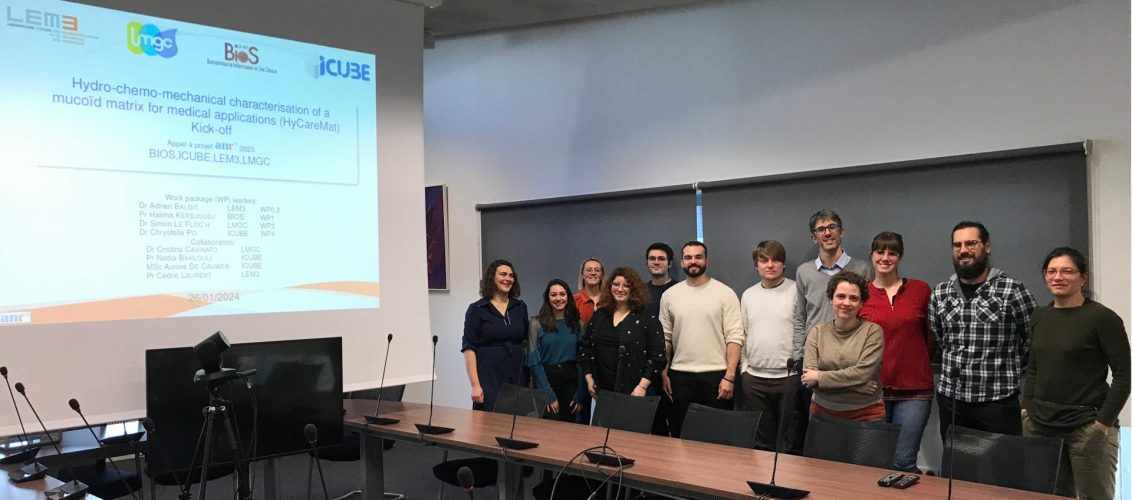
Kick-off 2023
Bibliography
Adamiak, K., Sionkowska, A., 2020. Current methods of collagen cross-linking: Review. Int. J. Biol. Macromol. 161, 550–560. https://doi.org/10.1016/j.ijbiomac.2020.06.075
Bacsich, R., Riddell, W., 1945. Structure and Nutrition of the Cornea, Cartilage and Wharton’s Jelly. Nature 271.
Baldit, A., 2018. Micromechanics of the Intervertebral Disk, in: Ganghoffer, J.-F. (Ed.), Multiscale Biomechanics. Elsevier, pp. 455–467.
Baldit, A., 2013. Étude des interactions hydro-chimio-mécaniques dans les tissus biologiques : Application à la nutrition du disque intervertébral (Mécanique, Génie Mécanique et Génie Civil). University of Montpellier 2, LMGC – UMR 5508, Université MONTPELLIER II, 860 rue de St Priest, 34090 Montpellier, France.
Baldit, A., Dubus, M., Sergheraert, J., Kerdjoudj, H., Mauprivez, C., Rahouadj, R., 2022. Biomechanical tensile behavior of human Wharton’s jelly. Journal of the Mechanical Behavior of Biomedical Materials 126, 104981. https://doi.org/10.1016/j.jmbbm.2021.104981
Beiki, B., Zeynali, B., Seyedjafari, E., 2017. Fabrication of a three dimensional spongy scaffold using human Wharton’s jelly derived extra cellular matrix for wound healing. Materials Science and Engineering: C 78, 627–638. https://doi.org/10.1016/j.msec.2017.04.074
Chetoui, M.-A., Ambard, D., Canãdas, P., Kouyoumdjian, P., Royer, P., Floc’h, S.L., 2022. Impact of extracellular matrix and collagen network properties on the cervical intervertebral disc response to physiological loads: A parametric study. Medical Engineering & Physics 103908.
Davidenko, N., Schuster, C.-F., Bax, D.-V., Raynal, N., Farndale, R.-W., Best, S.-M., Cameron, R.-E., 2015. Control of crosslinking for tailoring collagen-based scaffolds stability and mechanics. Acta Biomaterialia 25, 131–142. https://doi.org/10.1016/j.actbio.2015.07.034
Derrouiche, A., Zaïri, F., Zaïri, F., 2019. A chemo-mechanical model for osmo-inelastic effects in the annulus fibrosus. Biomech Model Mechanobiol 1773–1790.
Dubus, M., Scomazzon, L., Chevrier, J., Montanede, A., Baldit, A., Terryn, C., Quilès, F., Thomachot-Schneider, C., Gangloff, S.-C., Bouland, N., Gindraux, F., Rammal, H., Mauprivez, C., Kerdjoudj, H., 2022. Decellularization of Wharton’s Jelly Increases Its Bioactivity and Antibacterial Properties. Frontiers in bioengineering and biotechnology 10, 828424.
Fung, Y.-C., 1993. Biomechanics: Mechanical Properties of Living Tissues. Springer New York, NY.
Galbusera, F., Schmidt, H., Noailly, J., Malandrino, A., Lacroix, D., Wilke, H.-J., Shirazi-Adl, A., 2011. Comparison of four methods to simulate swelling in poroelastic finite element models of intervertebral discs. J Mech Behav Biomed Mater 4, 1234–1241.
Gervaso, F., Boschetti, F., Pennati, G., 2014. Evaluation of the Wharton’s jelly poroelastic parameters through compressive tests on placental and foetal ends of human umbilical cords. Journal of the Mechanical Behavior of Biomedical Materials 35, 51–58. https://doi.org/10.1016/j.jmbbm.2014.03.016
Lacroix, D., Brunelli, M., Perrault, C., Baldit, A., Shariatzadeh, M., Campos Marin, A., Castro, A., Barreto, S., 2019. Multiscale Mechanobiology in Tissue Engineering. Springer Nature Singapore.
Lacroix, D., Prendergast, P.-J., 2002. A mechano-regulation model for tissue differentiation during fracture healing: analysis of gap size and loading. Journal of Biomechanics 35, 1163–1171.
Lanir, Y., 1987. Biorheology and fluid flux in swelling tissues. I. Bicomponent theory for small deformations, including concentration effects. Biorheology 24, 173–187.
Latorre, M., Humphrey, J.-D., 2018. Critical roles of time-scales in soft tissue growth and remodeling. APL Bioengineering 2, 026108. https://doi.org/10.1063/1.5017842
Legouffe, R., Jeanneton, O., Gaudin, M., Tomezyk, A., Gerstenberg, A., Dumas, M., Heusèle, C., Bonnel, D., Stauber, J., Schnebert, S., 2022. Hyaluronic acid detection and relative quantification by mass spectrometry imaging in human skin tissues. Anal Bioanal Chem 414, 5781–5791.
Mow, V.C., Kuei, S.C., Lai, W.M., Armstrong, C.G., 1980. Biphasic Creep and Stress Relaxation of Articular Cartilage in Compression: Theory and Experiments. Journal of Biomechanical Engineering 102, 73–84. https://doi.org/10.1115/1.3138202
Ortún-Terrazas, J., Cegoñino, J., Palomar, A.P. del, 2021. Biomechanical impact of the porous-fibrous tissue behaviour in the temporomandibular joint movements. An in silico approach. Journal of the Mechanical Behavior of Biomedical Materials 120, 104542.
Pennati, G., 2001. Biomechanical properties of the human umbilical cord. Biorheology.
Scomazzon, L., Dubus, M., Chevrier, J., Varin-Simon, J., Braux, J., Baldit, A., Gangloff, S., Mauprivez, C., Reffuveille, F., Kerdjoudj, H., 2021. Use of crosslinked Wharton’s jelly in guided bone regeneration. Orthopaedic Proceedings 103, supp 13, 81–81. https://doi.org/10.1302/1358-992X.2021.13.081
Scomazzon, L., Ledouble, C., Dubus, M., Braux, J., Guillaume, C., Bouland, N., Baldit, A., Boulmedais, F., Gribova, V., Mauprivez, C., Kerdjoudj, H., 2024. An increase in Wharton’s jelly membrane osteocompatibility by a genipin crosslink. International Journal of Biological Macromolecules 255, 127562. https://doi.org/10.1016/j.ijbiomac.2023.127562
Uzuner, S., Li, L.-P., Kucuk, S., Memisoglu, K., 2020. Changes in Knee Joint Mechanics After Medial Meniscectomy Determined With a Poromechanical Model. J. Biomech. Eng. 142. https://doi.org/10.1115/1.4047343
Wilson, W., Donkelaar, C.C. van, Rietbergen, B. van, Huiskes, R., 2005. A fibril-reinforced poroviscoelastic swelling model for articular cartilage. Journal of Biomechanics 38, 1195–1204.